Next-Generation SFC with Antibacterial and Bioactive Functions
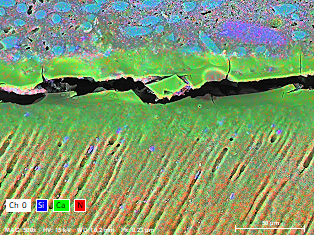
SEM image showing mineralization formation at the interface between demineralized etched dentin and experimental composite.
Next-Generation Fiber-Reinforced Resin Composites with Enhanced Antibacterial and Bioactive Functions
Project running time: Started in June 2026 with maximum duration of 2 years
Project contact person: Lippo Lassila, Head of TCBC, liplas@utu.fi
Funding source: Foundation Nakao for World-wide Oral Health
Dental resin composites are widely used for the repair of tooth decay due to their excellent esthetics and the minimally invasive preparation of tooth structures they require. However, these composites face significant challenges, including high failure rates and limited longevity, primarily caused by secondary caries and bulk fractures. Recent advancements aim to develop a new generation of restorative resin composites with either antibacterial and remineralizing properties or short-fiber-reinforced structures to enhance performance and extend the lifespan of restorations. These innovative materials show promise in inhibiting bacterial activity, reducing acid production, promoting mineral regeneration, and restoring the biomechanics of lost tooth structure, inspiring further basic and clinical research. Despite this research progress, achieving a single multifunctional composite that integrates multiple features—such as antibacterial efficacy, remineralization, and optimal mechanical properties—remains a significant challenge. Currently, no material in dentistry fully meets these demands.
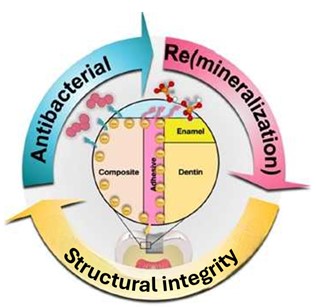
Therefore, this project seeks to address this gap by developing a short fiber-reinforced composite with an antibacterial polymer matrix designed to release ions, remineralize tooth structure, inhibit secondary caries, and restore the original biomechanical function of teeth.
We strongly believe that the successful innovation of such a restorative material has the potential to elicit both positive mechanical and biological responses in targeted tooth tissues. This breakthrough could improve the management of dental defects, extend the longevity of bonded restorations, and ultimately enhance patient care.
Funding for this project has been provided through a grant from Foundation Nakao for Worldwide Oral Health.